
Pilates for walkers in Harrogate: it's the descent that finds you out
Autumn is the best walking there is around here, and it's also when my phone gets busy. The first properly cold week arrives, everybody heads up Nidderdale or out to Brimham Rocks at the weekend, and by Monday I've had two or three messages saying much the same thing: the legs were fine going up, but the knees went on the way down, or the back was tight before I got back to the car.
If that sounds like you, here's what I'd say before you book anything at all — with me or with anybody else.
Going down is the bit nobody trains for
Going up is obvious effort. You're out of breath, your legs burn, and you know you've worked.
Coming down doesn't feel like effort at all, which is exactly why it catches people out. Every step is one leg absorbing your body weight plus whatever's in your rucksack, on its own, several thousand times in an afternoon. If your hip and glute aren't taking their share of that, the knee takes it instead. If your ankle can't control the landing, something further up sorts it out for you. And if you're carrying a pack, your mid-back and shoulders spend the whole descent holding you upright against something quietly pulling you backwards.
That's why the ache tends to turn up somewhere you weren't thinking about. Ten flat miles round the Stray and through the Valley Gardens bothers almost nobody. Four miles with a decent drop in it can leave you stiff for two days.
What helps, and what only feels like it helps
Stretching your quads at the end of a walk is pleasant and lasts roughly as long as the drive home. It isn't wrong. It just isn't the thing.
The thing is control on one leg: strength through the hip that keeps your pelvis level while the other foot is off the ground, ankles and feet that can manage a landing, and enough through the middle and the upper back to stay tall under a pack. It is dull to describe and it is slow, and in my experience it's what changes how the last hour of a long walk feels.
What we'd do about it in the studio
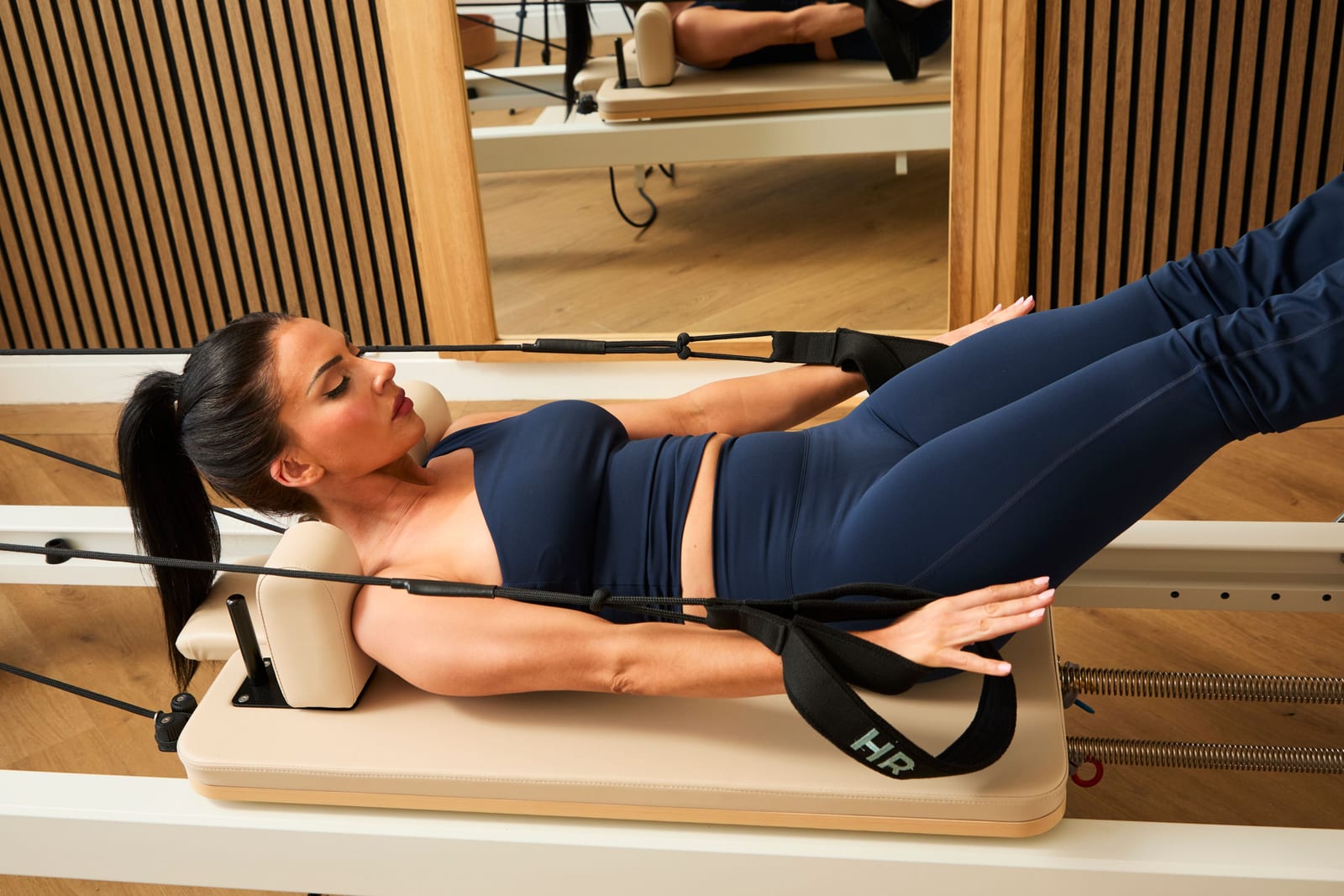
You'd come to the studio, which is a room at my home in Harrogate set up for reformer work and nothing else. One to one, 55 minutes, no class, no queue for the machine. We'd start with a conversation: where you walk, how far, how much descent is in it, what aches and how long after.
Then I'd set the springs from what you've just told me. That's the genuinely useful part of a reformer for this kind of work. The carriage can support some of your weight, so we can load one leg properly without asking a cross knee to hold all of you up while we do it — and I can change a spring in about five seconds, so the same movement gets harder as you get stronger without you having to climb off and start again.
For a walker, most of the hour tends to go on single-leg work, hips, ankles and feet, with enough shoulder and mid-back work to cope with carrying something. Very little of it looks impressive. Nearly all of the progress comes from small corrections — whether your knee tracks over your foot, whether your pelvis drops on the standing side, whether you're gripping with your toes to stay balanced — and those are exactly the things that get missed in a room of twelve people.
You'd leave with one thing to take away, usually something you can do on the kitchen floor while the kettle boils.
Before you book
If something is genuinely painful, get it looked at properly first. A knee that swells, anything travelling down a leg, an ankle that gave way once and has never quite been right: that needs somebody qualified to assess it, and that isn't me. I teach Pilates. I'm not a physiotherapist, and a session with me is not treatment or a diagnosis.
If you're already seeing a physio or an osteopath, tell me what they've said and I'll work inside it, and keep up the exercises they've given you rather than swapping them for my own. Them for the assessment, me for an hour a week of doing the work properly with somebody watching — that combination is how people tend to get somewhere.
Then check the unglamorous things, because they undo an hour of work faster than I can put it in. Boots you've had for nine winters. A pack with everything heavy sitting at the bottom. And going from a quiet summer straight to twelve miles on the first decent Saturday.
Between sessions
Keep walking. That's the whole point of it. Add distance or add hills, but try not to add both in the same week. And when you're out, notice whether there's a side you always favour on a stile or a steep step down — tell me about it, because it's usually the same side that shows up on the reformer.
Where to start
Most people begin with the introductory session at £45. It's a full 55 minutes, with time at the beginning to talk properly. After that a single session is £55, or a block of five is £220, which works out at £44 each. Mat sessions are priced separately.
Sessions run by appointment, 9am to 3pm, and clients travel in from Harrogate itself and from Knaresborough, Pannal, Killinghall, Spofforth, Wetherby and Ripon. Call or text me on 07960 746480, tell me where you walk and what complains afterwards, and I'll tell you honestly whether I can help.