
Stiff back from sitting all day? What I'd do about it in the studio in Harrogate
Nobody books a Pilates session because their back is fine. The message I get most often at this time of year is some version of the same thing: it isn't an injury, it doesn't stop me doing anything, but I'm stiff by Wednesday and it's getting worse. Usually the person sending it has gone from a summer of being outdoors most evenings to a laptop, a desk chair and a drive home in the dark.
Here is what I'd say before you book anything at all — with me or with anybody else.
It's rarely the back that's the problem
A lower back that aches after a day of sitting is usually doing somebody else's work. Hips that have stopped properly extending because they've been folded at ninety degrees since half past eight. A mid-back that has quietly given up rotating. Ribs that barely move, because when you're concentrating you breathe into the top of your chest and nowhere else. Movement has to come from somewhere, so the lower back takes the share that should have been spread out, and then it grumbles about it.
That matters because it changes what is worth doing about it. Stretching the sore bit feels lovely for twenty minutes and has usually worn off by Thursday. Getting the hips and the mid-back moving again, and then building enough strength to hold a better position without thinking about it, is slower and considerably duller — and it's the one that holds.
What to sort out before you book
If it's genuinely painful, get it looked at properly first. Pain travelling down a leg, pins and needles, anything that wakes you in the night, anything that arrived suddenly after a lift: that needs somebody qualified to assess it, and that isn't me. I teach Pilates. I'm not a physiotherapist, and a session with me is not treatment or a diagnosis. I'd much rather say that to you on the phone than discover it halfway through an hour.
If you're already seeing a physio or an osteopath, tell me what they've said and I'll work inside it. I'll keep up the exercises they've given you rather than replacing them with my own. Them for the assessment, me for an hour a week of doing the work properly with somebody watching — that combination is how people tend to get somewhere.
And before you spend money on anything, look honestly at the eight hours. Screen at eye height or halfway down your chest? Laptop on the kitchen island for "just this morning" since March? A commute where you sit twisted towards the gearstick? None of that is glamorous to fix and all of it undoes a session faster than I can put it in.
What we'd actually do
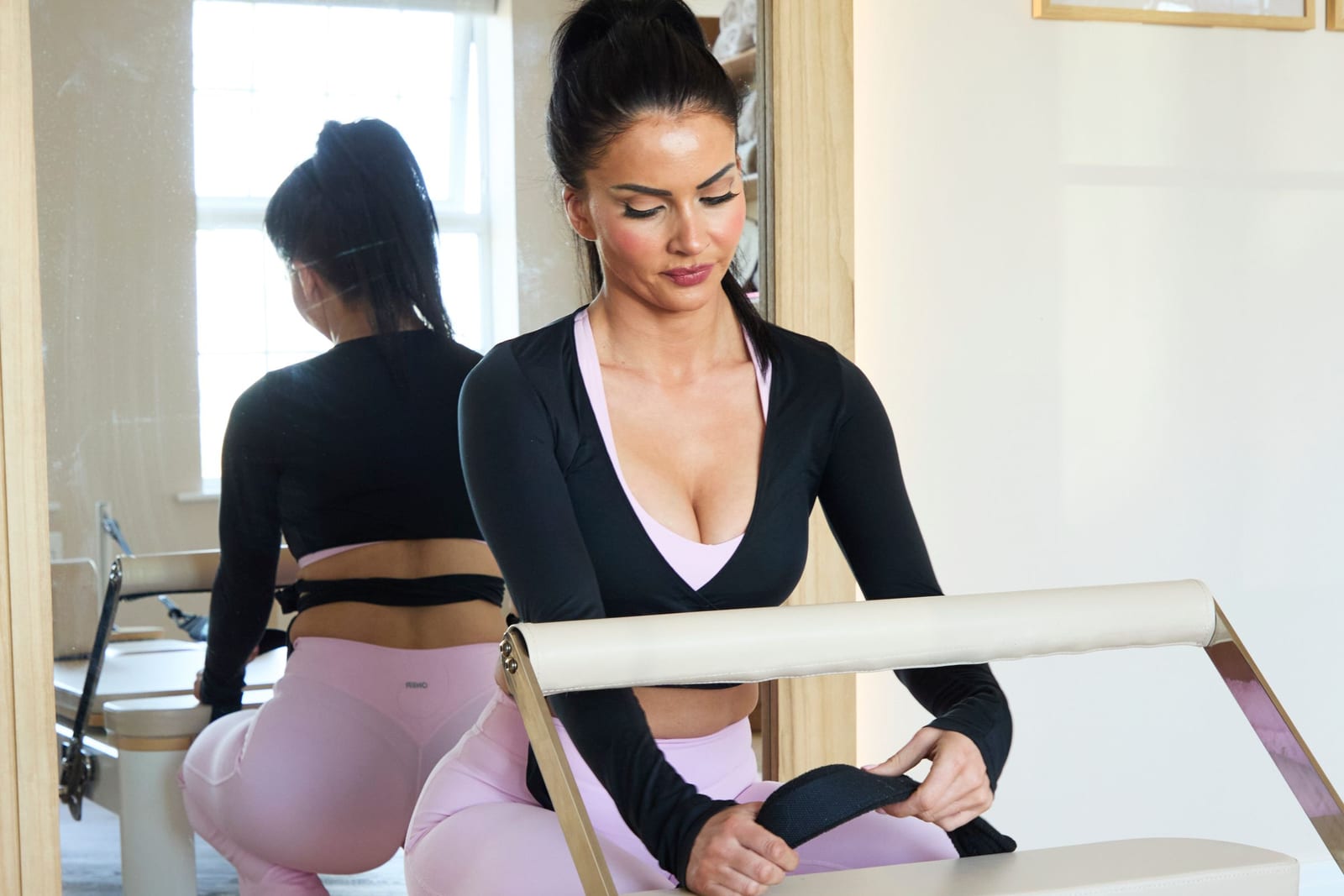
You'd come to the studio, which is a room at my home in Harrogate set up for reformer work and nothing else. One to one, 55 minutes, no class and no queue for the machine. We'd start with a conversation: when it hurts, when it doesn't, what you were doing the last time it flared, what a normal Tuesday looks like for you.
Then I'd set the springs from what you've just told me. That's the useful thing about a reformer — the carriage can take some of your weight, so we can work a muscle hard without asking a cross lower back to hold you up while we do it. As things settle, the spring changes. Same movement, more demand, adjusted in about five seconds while you stay where you are.
For a desk back, most of the hour tends to go on hips, the mid-back and breathing, in that order, with strength work through the middle once you can find the position. Very little of it looks impressive. Almost all of the progress comes from small corrections — where your ribs sit, what your pelvis does when your leg moves, whether you're holding your breath through the hard part — and those are exactly the things nobody spots in a room of twelve.
You'd leave with one thing to take away. In autumn it's nearly always something to do at your desk, because that's where the problem is being made.
Between sessions
Three things, and none of them cost anything. Get up more often than feels necessary; the best position is the one you haven't been in for forty minutes. Learn to breathe so your lower ribs move sideways, and use it at your desk rather than only on the reformer. And keep walking — Harrogate is well set up for it, and twenty minutes at lunchtime does more for a stiff back than an hour of good intentions in the evening.
Where to start
Most people begin with the introductory session at £45. It's a full 55 minutes, with time at the start to talk properly. After that a single session is £55, or a block of five is £220, which works out at £44 each. Mat sessions are priced separately.
Sessions run by appointment, 9am to 3pm, and clients travel in from Harrogate itself and from Knaresborough, Pannal, Killinghall, Spofforth, Wetherby and Ripon. Call or text me on 07960 746480 with a line about what your back does and when it does it, and I'll tell you honestly whether I can help.